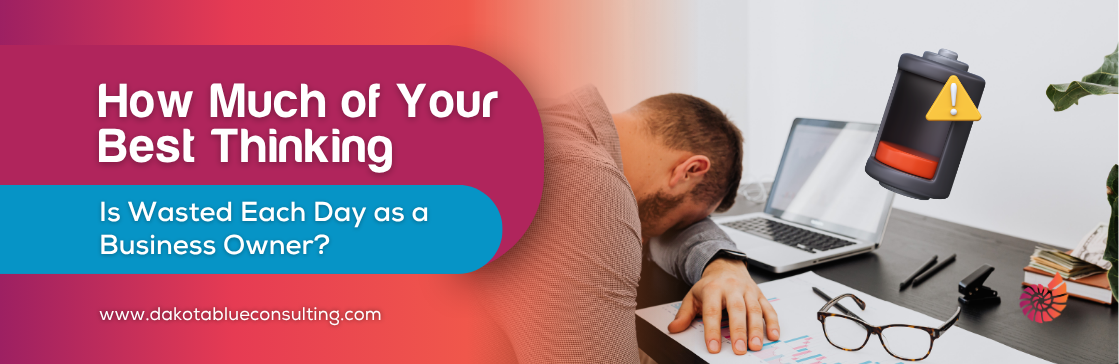
How Much of Your Best Thinking Is Wasted Each Day as a Business Owner?
The Decisions You Make Before 9am
Before you even begin your working day, you have already made a stream of decisions.
What to wear. What to eat for breakfast. Whether you need to replace something that is still perfectly usable. What to make for dinner. Whether you should try something new. Whether you have time to pick up groceries.
Each choice feels small. None of them seem important. Yet each one requires a moment of thought, comparison or judgement.
By the time you sit down to work, part of your mental energy has already been used.
The Battery That Drains in the Background
Think of your mental energy like a phone battery.
You start the day at one hundred percent. Each decision is like an app running in the background. One or two makes little difference. Twenty or thirty slowly drain the charge. By mid afternoon, when you really need full power for a critical call or a difficult conversation, you are already on low battery mode.
Nothing dramatic happened. You just did not notice how many small processes were quietly running.
That is how decision fatigue works. It is rarely one big moment. It is the steady accumulation of small choices.
Why This Matters More When You Run a Business
As a business owner, you are not just deciding what to have for dinner. You are making judgement calls that affect people, profit and direction.
You are deciding who to hire. How to handle underperformance. Whether to increase salaries. How to respond to a difficult client. Whether now is the right time to invest.
When your mental battery is drained by low value choices, the quality of those higher stakes decisions suffers. You may delay them. You may rush them. Or you may default to what feels easiest rather than what is right.
This is not about capability. It is about capacity.
Some well known leaders have understood this for years. Steve Jobs wore the same style of outfit daily. Mark Zuckerberg took a similar approach. Barack Obama limited his suit choices while in office. They were not trying to make a fashion statement. They were reducing trivial decisions so they could protect their focus for more important ones.
You do not need to copy their wardrobes to apply the principle.
Resist the Upgrade Reflex
We are constantly encouraged to buy, refresh and upgrade. New clothes for a new season. A new device because the current one feels outdated. A new system because someone says it is better.
If something is still working well, it is worth asking why you are changing it.
Every new purchase creates more decisions. Which option to choose. How much to spend. How to set it up. Whether it was the right call. Simplicity is often underrated. Keeping things steady where you can preserves energy for where change is genuinely needed.
Plan Once, Decide Less
One of the simplest ways to protect your headspace is to plan ahead.
A basic meal plan for the week. A small rotation of go to dinners. A recurring grocery list. Laying out clothes the night before. None of this is revolutionary. Yet it removes repeated daily deliberation.
Spending a short amount of time planning once prevents you from having the same internal debate every day.
The same applies at work. Clear processes for common issues. Agreed spending limits. Standard approaches to minor people matters. These reduce the number of decisions that need to come back to you.
Stop Carrying Every Small Call
Many business owners are involved in decisions that do not truly require their input.
When every small operational query lands with you, your mental battery drains faster than it should. Delegation is not about stepping away from responsibility. It is about creating clear guardrails so your team can make day-to-day decisions confidently.
When people understand the boundaries, they do not need to check every detail. That protects your time and builds their confidence at the same time.
Protect Your Best Thinking
Your clarity is one of your most valuable assets as a leader. If it is spent on low stakes choices, there is less left for the decisions that shape your business.
Take a look at your typical week. Where are your decisions going? Which ones genuinely need your judgement? Which ones are habits, impulses or avoidable distractions?
Small adjustments in how you buy, plan and delegate can make a noticeable difference. Not because they transform your life overnight, but because they quietly preserve the energy you need for the work that really matters.
Redesign your work flow
If you are constantly pulled into small operational decisions and feel your focus slipping, it may be time to redesign how work flows through your business. At Dakota Blue Consulting, we help business owners put clear people processes and practical structures in place so they can lead with more clarity and less noise.
Get in touch to start protecting your headspace and strengthening your decision making where it counts most.