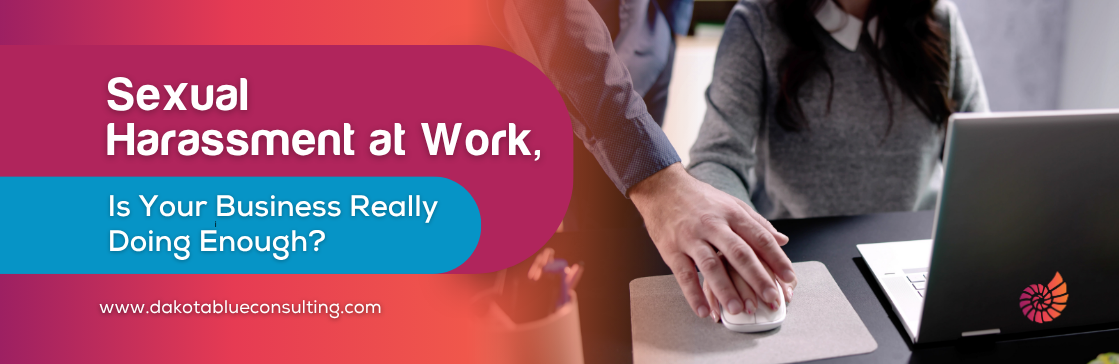
Sexual Harassment at Work, Is Your Business Really Doing Enough?
Since October 2024, every employer has had a legal duty to take reasonable steps to prevent sexual harassment in the workplace.
For many businesses, that prompted a review of policies and employee handbooks. But while policies are an important starting point, they are only one part of meeting your legal responsibilities.
The real question is this:
Could you demonstrate that your business has taken practical steps to prevent sexual harassment before a complaint is made?
"We'd never have a problem like that here."
It is one of the most common responses we hear when speaking with business owners.
The uncomfortable reality is that many people who experience sexual harassment never report it. Some worry they will not be believed. Others fear the impact on their career, while some simply do not recognise that what they have experienced amounts to sexual harassment.
That is exactly why the law changed.
Employers are now expected to take a proactive approach, creating workplaces where inappropriate behaviour is understood, challenged and less likely to occur, rather than simply responding when something goes wrong.
Policies alone do not change behaviour
Many businesses have updated their policies and believe the job is done.
Unfortunately, that is rarely enough.
If employees have never discussed what sexual harassment looks like in practice, how can they be expected to recognise it?
Not every incident is obvious.
It may involve repeated comments that are dismissed as jokes, unwanted compliments, inappropriate messages, behaviour at work social events or conduct that makes someone feel uncomfortable, even if no offence was intended.
Intent does not determine whether behaviour amounts to sexual harassment. The impact on the individual is what matters.
That is why awareness and education play such an important role.
Is "I didn't mean it" still enough?
One of the biggest discussions following the change in the law is whether businesses should still rely on employees saying, "I didn't mean it."
The reality is that people often have very different views about what is acceptable.
What one person considers harmless banter, another may experience as intimidating, degrading or offensive.
Without clear conversations, practical guidance and regular training, businesses leave too much open to interpretation.
Creating awareness is not about policing every conversation. It is about helping people understand professional boundaries, encouraging respectful behaviour and giving everyone the confidence to speak up if something does not feel right.
Managers play a critical role
Managers shape workplace culture every day.
If inappropriate behaviour is ignored, laughed off or minimised, employees quickly learn that raising concerns is unlikely to make a difference.
Managers need the confidence to recognise issues early, respond appropriately and know when to involve HR or take further action.
Addressing concerns promptly protects both employees and the wider business.
What do "reasonable steps" actually look like?
Every business is different, but taking reasonable steps is likely to include a combination of:
- Reviewing and updating workplace policies.
- Providing regular Sexual Harassment Awareness Training.
- Helping managers understand their responsibilities.
- Creating clear reporting procedures.
- Responding appropriately when concerns are raised.
- Regularly reviewing workplace culture rather than waiting for complaints.
Training has become one of the clearest ways of demonstrating that your business is taking its preventative duty seriously.
This is not simply a compliance issue
Sexual harassment can affect far more than legal compliance.
It can damage employee trust, increase staff turnover, consume valuable management time and affect your reputation as an employer.
Recent employment tribunal cases have also shown how costly sexual harassment claims can become, with some resulting in compensation awards of hundreds of thousands of pounds. Since October 2024, tribunals may also increase compensation by up to 25% where an employer has failed to take reasonable steps to prevent sexual harassment.
For most SMEs, the greatest risk is not deliberate inaction. It is assuming that having a policy is enough, when employees and managers may never have been given the knowledge or confidence to apply it in practice.
Could you evidence what you've done?
If the Equality and Human Rights Commission or an Employment Tribunal asked what practical steps your business had taken to prevent sexual harassment, what evidence could you provide?
Policies are important.
Training records, manager awareness, communication and a culture that encourages respectful behaviour all help demonstrate that your business has taken its responsibilities seriously.
Ultimately, protecting your people is about more than complying with the law. It is about creating a workplace where everyone feels respected, safe and able to do their best work.
Looking for practical support?
If your employees have not received dedicated Sexual Harassment Awareness Training since the law changed, now is a good time to review whether your business has done enough to support its preventative duty.
Our 40-minute interactive Sexual Harassment Awareness Training is delivered live by one of our experienced HR Directors and is designed to help employees and managers understand their responsibilities through practical discussion and real workplace examples.
Whether you're looking to strengthen your workplace culture, support your managers or demonstrate the practical steps your business has taken, we're here to help.